What an exception report can’t tell you about the loss behind it

How to sort register loss into three causes before you pay to fix the wrong one
A bar comes up three bottles short at the end of the month. The owner can read that number three ways: heavy pours, drinks comped for friends, or a bottle carried out the back. With the same shortage, there are three causes and three fixes — a jigger, a policy, a lock. But if you buy the lock when the problem is the pour, the count is going to come up short again next month.
Registers work the same way. Net margin lands below plan on the P&L, and the exception report offers a cashier’s name as the explanation. That cashier might be converting product to cash inside one shift. The overrides under their ID number might trace to a shelf tag nobody updated. Or it could be that the loss never touched the register at all.
Pedro Ramos, SVP, Strategic Alliances at Appriss Retail, is back to help spot the patterns across retailers who count shrink in different ways. He believes you need to unearth the cause before you spend on the fix.
Key takeaways:
- Most cashiers with high exception counts are overloaded or working around bad shelf tags rather than stealing.
- Point-of-sale data tells you a register is behaving unusually. Inventory data tells you whether the loss started inside the store or outside it.
- Recovery lands as margin whether or not a retailer carries a shrink line on the P&L.
Three kinds of loss, one exception report
Register loss comes from three sources, and all three draw down the same number on the P&L: the gap between the gross margin a business planned for and the net margin it kept. Some retailers explain that gap with a shrink line just below gross margin. Others never break shrink out at all, so the loss shows up only as net margin coming in under plan. The gap is the same size either way. LP teams tend to be set up to catch one of the three causes, but most exceptions aren’t theft. Treat every exception as theft, and the other two causes keep running.
-
Internal fraud
This is the cause teams look for first, and the fake refund is one of the most common versions. An associate refunds an item to cash using overrides, and the till balances on paper. Pedro tells the rest the way that associate would: “I’m doing refunds and I’m not giving the cash back out to a consumer. At the end of the day, I take the cash and I go home.”
Nothing leaves the building. The product, the sale, and the cash all convert inside one store, which makes the whole loop far less visible than the product walking out the front door.
Post voids and last-item voids leave cash in the till the same way, canceling a paid sale or dropping one item off a cash receipt the customer never reads. Unauthorized discounts, miscellaneous codes, and items that never get rung up let a friend walk out with a full bag after paying for part of it.
-
External theft
Product disappears with no matching behavior at the register, so an exception report built on register data alone has nothing to flag. The loss shows up only in inventory, which is why any exception-based reporting (EBR) tool needs inventory data layered into it.
-
Operational errors
Everything else lands here: mispriced items, promotions that never came off the file, and shipments that arrived a case short without anyone catching it at receiving. None of it is theft, but all of it shows up on the same exception report in the larger bucket of fraud.
How to sort the data you already have
Everything starts at the register. “At its core, it starts with point of sale,” Pedro says. “Therefore, the focus initially can be the cashiers.” This is what Appriss built Secure to do, scoring transaction data for anomalies that are, in Pedro’s words, “indicative of fraud, operational, or systemic issues that are driving losses.”
Let all three causes surface together
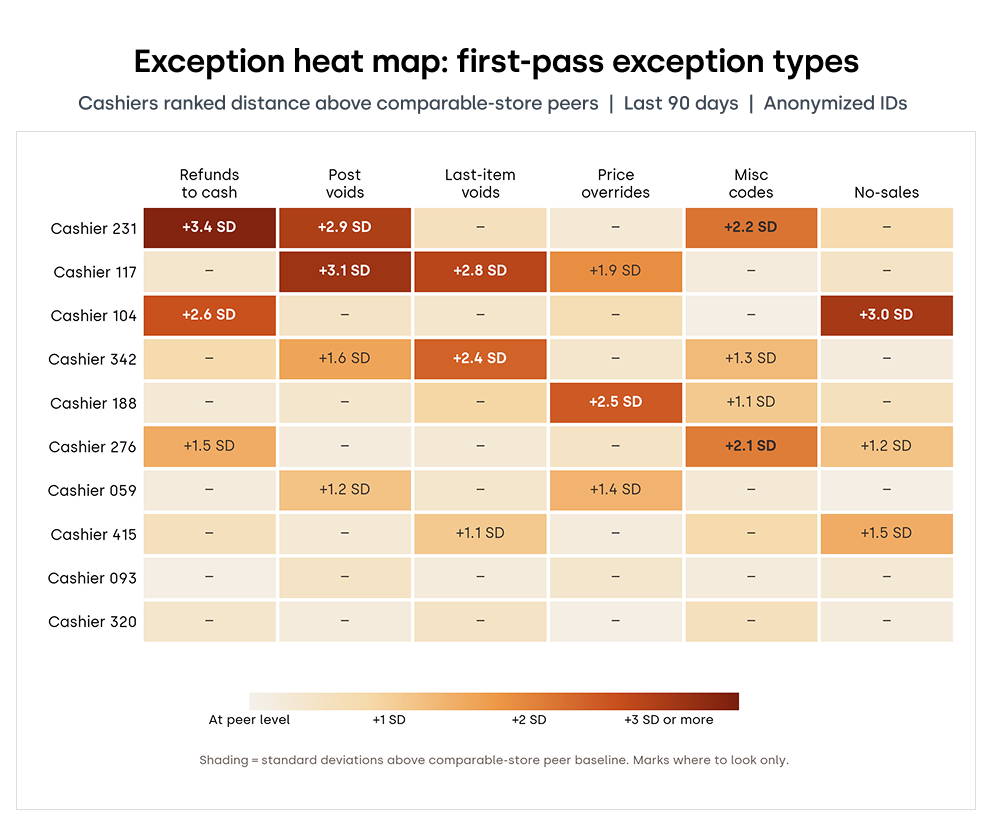
What surfaces in the first pass: refunds overridden to cash, post voids, last-item voids on cash sales, price override rates, miscellaneous codes, and no-sale counts sitting outside what comparable stores produce.
All three causes show up together here, and that is the point of the initial pass. A cashier stealing and a cashier drowning at 5 p.m. both land on the same list, and so does an item that will not scan. You are building the map of where the register behaves unusually, not assigning motive to the names on it.
Put product movement next to register behavior
Point-of-sale data tells you a cashier is an outlier. But what about whether the loss started inside the store or outside it? Inventory movement answers that.
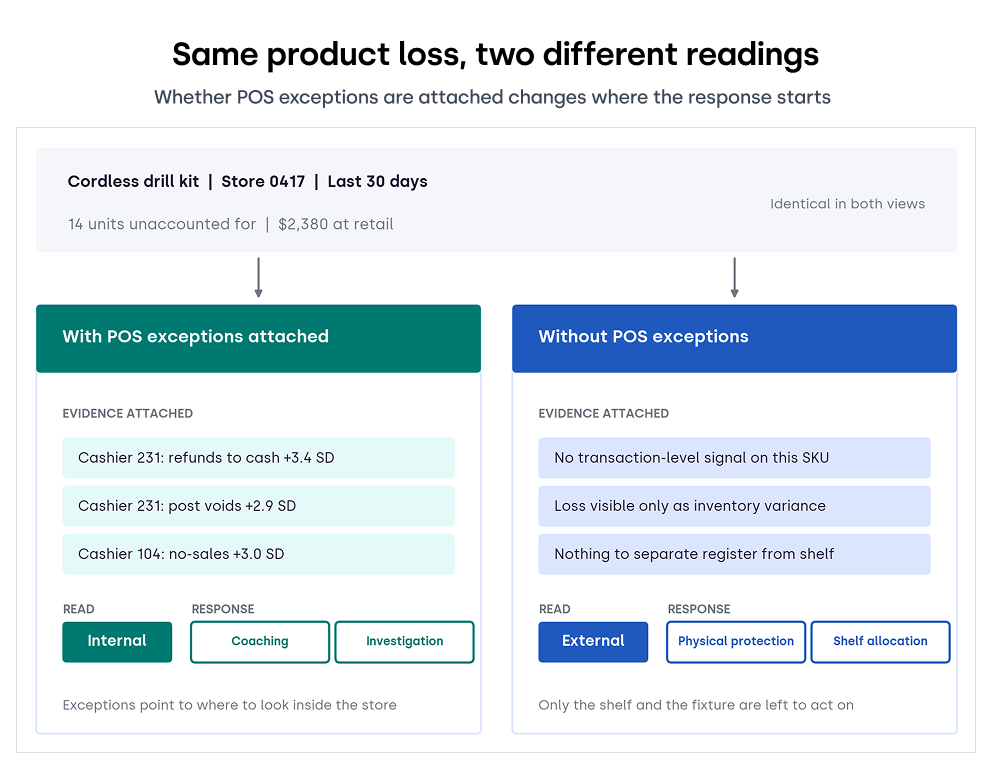
Adding inventory data puts product velocity next to the register exceptions from step one. “If an item gets shipped into the store at a higher velocity than it’s sold, and there’s no correlating point-of-sale fraud exceptions, then the likely loss is external,” Pedro says.
High loss on a product that matches register behavior points internal. High loss with nothing unusual at the register points external, and that changes what fix you put in place: physical protection on the item, reduced shelf allocation so the product is a less tempting grab without hurting sales, or security personnel posted to the department where product is disappearing.
This is the jigger-or-lock question, and the register cannot answer it alone.
Sort the theft from the bottleneck
A high exception count is not proof of theft. “Cashiers that have very high [exceptions], price overrides, voids, and so forth, aren’t necessarily always malicious,” Pedro says. “It could just be a cashier that’s poorly trained and struggling with the overflow.”
Three things do the sorting.
→ The type of exception matters more than the count: refunds converted to cash and post voids describe a behavior nobody performs by accident, while price overrides and unscanned items describe a workaround.
→ Timing matters next, since exceptions that spike with store flow and peak hours describe a trend, not a scheme.
→ Then comes the item, because overrides that are clustering on the same SKUs point past the cashier entirely.
Send the fix upstream of the register
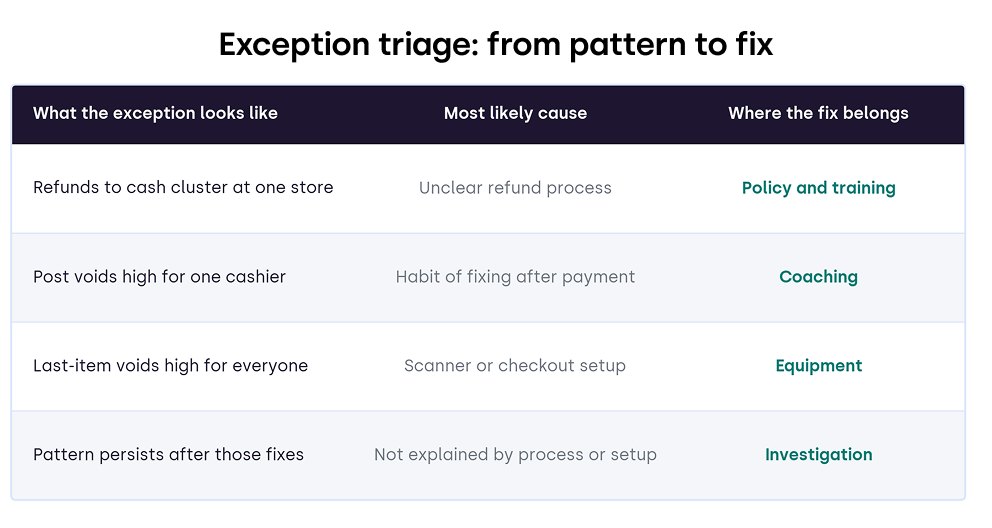
When overrides trace to items that will not scan or carry bad tags, the answer is merchandising. “Fix the core issue, like shelf tagging, and you will have lower price overrides and improve your sales per labor hour,” Pedro says.
Correcting the UPC or the tag removes the exception at the source. Same with a promotion that ended without the system updating, which leaves a cashier standing in front of a customer with nothing to offer except a discount. That cashier is working around a gap somebody upstream left open.
Front-end productivity moves with it. Sales per labor hour, the sales each front-end associate produces in an hour worked, climbs when cashiers stop stopping. The same correction reduces loss and speeds up the line, which is the version of this story an operations leader will fund.
The pour, the policy, and what you actually needed
“We could reduce shrink by 6% or basically improve margins by 6%,” Pedro says regarding what could be recovered. “It’s the same thing.” It lands as margin whether or not a shrink line exists to absorb it, which is the number finance can act on.
The rest of the return is what you stop having to pay for: better allocation of precious capital on preventing external theft where it may not be as impactful. Coaching costs less than an investigation, and the security budget goes to the product with external loss attached.
Scoring transactions finds the loss, but can’t stop it mid-shift. A comp policy taped to the register has never stopped a single free drink. Somebody has to be standing there when the pour happens.
Frequently asked questions
How do I tell a cashier who is stealing from one who is overwhelmed?
Read what kind of exception it is and when it happens, not how many there are. Refunds overridden to cash, post voids on closed transactions, and last-item voids on cash sales describe deliberate behavior. Price overrides and unscanned items usually describe a workaround. Then check timing and product: exceptions that spike during peak store flow point to volume and training, and exceptions that cluster on the same items point to pricing or shelf tagging rather than the person ringing them. Counts alone will mislead you, because a busy store produces more of everything. Compare a cashier against peers working similar volume before anyone opens a case.
Does sorting register loss by cause still work if we don’t measure shrink?
Yes. The method targets the gap between the margin a buyer expected and the margin the business actually kept, and that gap exists whether or not a line item on the P&L explains it. Some profitable retailers never calculate shrink at SKU level because the nature of the business does not reward it. Others measure at retail, others at cost, and the same units lost produce very different numbers depending on which one they picked. “So the P&L impact, whether they measure shrink or not, from Secure is the exact same thing,” Pedro says. For an LP leader, that reframe is useful internally as well, because margin is the language finance already runs on.
What changes in the store when Secure starts scoring our register data?
When used to its fullest capacity to address total loss, Secure will manifest a change in shrink/margin. That’s important to store operators because it’s one of the items they work so hard to manage and it’s frequently tied to compensation. The other changes are more subtle; better cashier performance overall, better customer experience, less systemic issues. With transactional and inventory data, the operators will save time finding root causes to problems. Secures will do that and send action plans.
Does internal loss look the same across store formats?
No, and the difference should change where you put your controls. Internal exposure runs heavier in apparel than in a grocer or big box that carries perishables. For example, in apparel there are fewer but higher priced SKUs and the store’s annual revenue is far lower than the grocer or big box. The other stores have perishables which are more influenced by external and operational factors. One or two associates can impact a department (say electronics) more than the total store.
None of this suggests the principles we addressed have any less merit. Fraud, training and other operational issues all have an impact on shrink and margin and should be addressed consistently across all verticals.