
Why CFOs can’t see their biggest margin opportunity

Why CFOs can’t see their biggest margin opportunity
A CFO’s guide to budget allocation across siloed departments
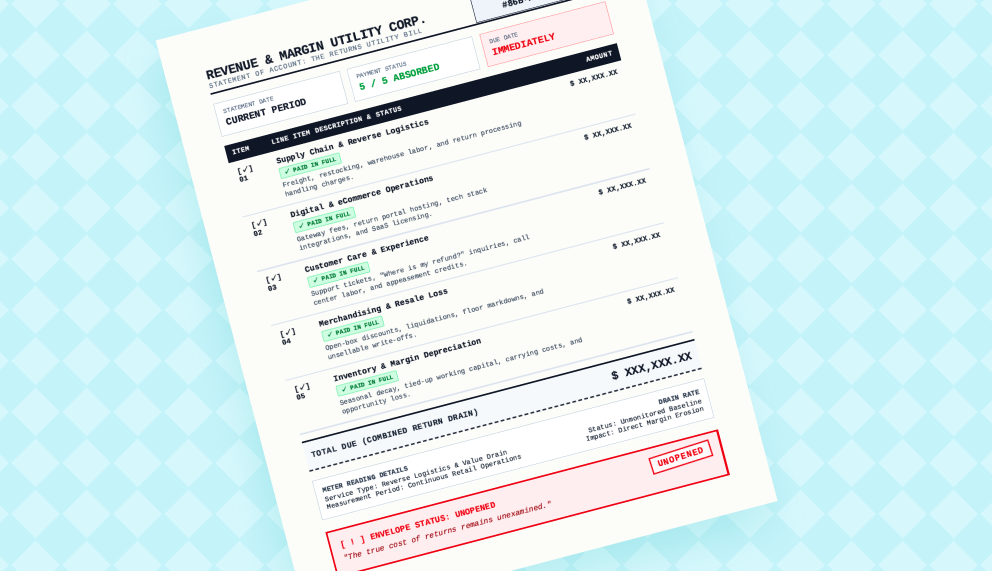
Five roommates split a utility bill: each one pays their portion on time, each one assumes the total is being handled, but no one opens the full statement to see what the household spent.
For retailers, that looks like:
- Supply chain wanting dollars for returns processing efficiency
- Digital wanting a fraud detection line
- Customer care wanting a bigger appeasement allowance
- Merchandising wanting a product feedback tool it’s calling “returns intelligence.”
- Inventory absorbing the margin lost to product depreciation, with no budget line asking to fix it
A CFO opens the September budget file and sees five requests, five different owners, and not one of them naming the same total.
“Who’s looking at returns holistically; how they affect conversion, loss, retention, loyalty, and the overall customer experience?” Antonio Colicchio asks. “When you take that broader view, returns are no longer just a supply-chain or customer-care issue. They are a core part of the customer relationship and a meaningful driver of a company’s profitability and overall health.”

Colicchio built the first-ever Returns, Fraud, and Abuse department at a major global apparel retailer, after leading global customer care and digital fraud organizations at other large specialty and off-price retailers. He still hasn’t met another VP with “Returns” in the title at a retailer of any real size. Every function on that list already owns its own work and should keep owning it. What nobody owns is the outcome those functions add up to.
Key Takeaways:
- Returns budget requests get split across five areas, and no one is accountable for the outcome those pieces produce together.
- Antonio Colicchio estimates 30 to 50 percent of returns stem from missing product information, policy misalignments, promotional structures, and operational inconsistencies. The real share could be higher.
- A $4 billion retailer can be sitting on $800 million in returns, an opportunity most CFOs never scrutinize the way they scrutinize comp sales growth.
When every department sees a slice, not the whole
When a CFO reviews budget requests, five different departments show up asking for their own piece of it: supply chain for processing efficiency, digital for fraud prevention, customer care for appeasements, merchandising for product feedback tools, and inventory absorbing depreciation losses no one bills for. Each request makes sense on its own. None of them add up to a full picture.
For a retailer doing $4 billion in revenue, that unopened statement runs to roughly 800 million dollars in returns. Most CFOs apply more scrutiny to a 2 percent comp sales target than they do to a bill nobody’s added up.
The different silos not understanding the entire problem, or still fighting for position, keep retailers from doing what Pedro Ramos, Appriss Retail’s SVP of Strategic Alliances, sees as the right move: putting one person — a CFO or a VP of Returns — in a seat where they’re accountable for the whole number. That doesn’t mean this person is doing every department’s job. Those responsibilities and outcomes are still held to each department, but they’re making sure nobody’s flying blind on their piece of it, and that the pieces get compared before the money gets committed.
Colicchio’s point is that no department is more important than the other but none of these are being looked at together.
Three questions that reveal who should own returns
Before a budget line gets a name or a title gets a mandate, Colicchio works through three questions in order to identify who needs to be accountable.
Question 1: What’s our total returns cost, not just processing cost?
Most retailers can tell you their supply chain returns cost. Few can quantify customer attrition from bad returns experiences, or the product intelligence that never reaches merchandising.
“If you’re not paying attention to the components of loss, supply chain, customer care, appeasements, fraud, customer attrition, margin erosion, then you’re not measuring those things to any extent. You end up losing money, and you don’t even know how much money you’re losing,” Colicchio says. Without that visibility, the recoverable value stays invisible too.
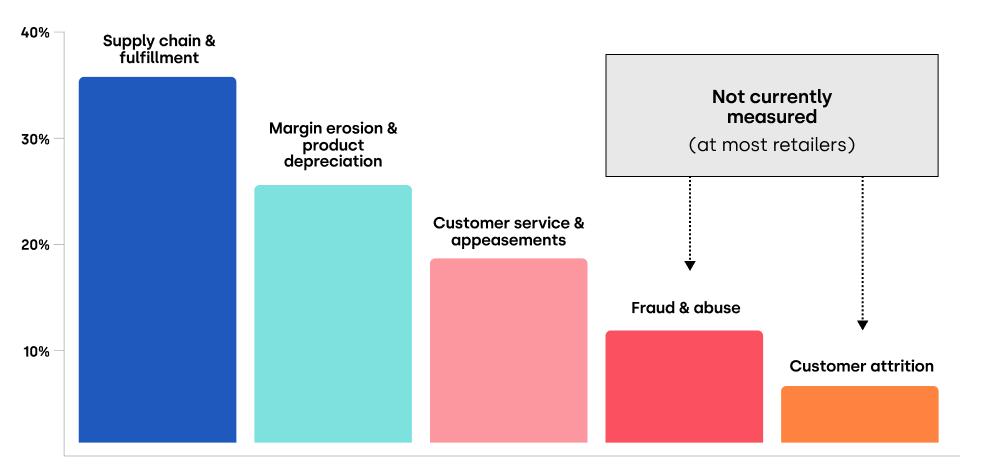
He breaks direct returns cost into five line items, in order of size:
- supply chain and fulfillment
- margin erosion and product depreciation
- customer service and appeasements
- fraud and abuse
- customer attrition
Product depreciation is the least visible: extra time in transit or in a customer’s hands pushes an item closer to missing its peak selling window, so it resells for less even when it comes back. Add signal loss on top of attrition, and the total runs well past what any one department’s payment shows.
Understanding the hidden cost of returns
Question 2: What percentage of our returns are controllable?
Colicchio estimates 30 to 50 percent of returns stem from missing product information, policy misalignments, promotional structures that encourage low-quality add-on purchases, and operational inconsistencies across teams. He believes the true number may be even higher.
If half of returns are preventable, those investments compete on different terms than a pure fraud or logistics problem would.
Understanding these numbers is important for how the budget gets allocated.
Question 3: Who’s accountable for the total outcome, and do they have the authority to act?
“Before deciding who owns returns, retailers have to define what returns actually means. If it only means processing an item after it comes back, supply chain is the obvious choice for them. But that would be a mistake. Returns affect far more than just processing; they touch the customer experience, conversion, loyalty, fraud, and margin. That requires broader ownership,” Colicchio says.
→ Processing sits with supply chain.
→ Customer experience sits decentralized across product teams, marketing, customer service, etc.
→ Product quality sits with merchants and/or sourcing teams.
→ Fraud sits with LP.
Most retailers hand the whole thing to whichever department owns processing. Supply chain often carries the largest visible cost line on the returns statement, so the logic holds up on a spreadsheet. What it misses is scope. Supply chain controls one dimension of the problem: what happens to an item after it comes back. A reverse logistics operation can run beautifully and still have no ability to change why the return happened, whether the cause was product, merchandising, marketing, digital experience, policy, or fulfillment. It also doesn’t own what happens downstream, in conversion, loyalty, customer attrition, fraud, or margin. That’s the case against letting returns default to supply chain.
Colicchio’s view: returns belong under a VP or Chief Returns Officer reporting to the CEO or CFO, or, second best, into the digital business with a dotted line to merchandising and supply chain. That person orchestrates. Processing stays with supply chain, customer experience stays decentralized, product quality stays with merchants and sourcing, fraud stays with LP, and every one of those teams keeps owning the work and the results inside its own walls.
Separating the two kinds of ownership makes the role easier to define. One person is accountable for the overall returns outcome. Many people stay responsible for the individual drivers they can actually influence. The orchestrator’s job is the work in between: build the total view, find the opportunity, trace it to a root cause, hand that cause to the function that can fix it, confirm the action happened, measure whether the number moved, then run the cycle again.
That seat also settles the arguments nobody else can. When optimizing one function’s budget or KPI would leave the enterprise worse off, somebody needs both the visibility to catch it and the standing to call it.
Consolidating the reporting is the first week of that job. Visibility on its own changes nothing. What makes the role worth funding is the accountability and the action that follow it.
Most retailers haven’t settled who holds that accountability internally. But the customer experience side of the question — how returns actually affect conversion, loss, retention, and loyalty — is already moving, whether or not anyone’s claimed it yet.
Where to start before the title exists
Colicchio still hasn’t met another VP with “Returns” in the title at a retailer of any real size, which means most CFOs reading this can’t act on his recommendation as written. The three questions work anyway. They need somebody willing to answer them out loud in a room where the CFO is sitting.
Take the largest line on the statement and follow it end to end. When appeasement spend climbs, the cause usually sits somewhere else: a product page that oversells, a policy that varies by channel, a promotion pushing low-quality add-ons into baskets. Trace it there, name the person who can change it, agree on what the fix is worth against what the returns cost, and put a date on the follow-up.
Then do the next line.
That sequence is the job, whether one person runs it under a new title or a small group runs it on borrowed time. Opening the statement is the first hour of it. The rest is reading which line moved, finding out why it moved, handing it to whoever can change it, and checking next month’s bill to see whether anything did.
Frequently asked questions
Why can’t we just assign returns to supply chain since they already handle processing?
Supply chain often carries the largest visible cost line in returns, which is exactly why the assignment feels logical. The limit is scope. Supply chain controls what happens to an item after it comes back, not the product information gaps, policy misalignments, promotional structures, and operational inconsistencies that Colicchio estimates drive 30 to 50 percent of returns in the first place. It also doesn’t own the downstream effects on conversion, loyalty, customer attrition, fraud, or margin. Assigning ownership by who already touches the box gets you an efficient reverse logistics operation and leaves the rest of the number unclaimed.
How do we calculate our total returns cost if we’ve never measured attrition or signal loss before?
Start with what you already have. Supply chain cost is usually tracked closely. Layer in appeasement spend from customer care and fraud losses from digital, since most retailers have these numbers, just not in one place. Attrition and signal loss are harder to quantify precisely, but even a directional estimate, like repeat purchase rate among customers who had a poor returns experience versus those who didn’t, gives a CFO enough to see the real number is bigger than the processing line alone.
What if our organization isn’t ready for a VP of Returns? What’s the smaller first step?
Start by asking who currently has visibility across all the departments returns touch, even informally, and give that person a standing seat in budget conversations across supply chain, customer care, digital, inventory, and merchandising. Ask them for one thing: the total, plus a named owner for each of the biggest drivers behind it. Authority to act can follow once the CFO can see the full number those conversations are protecting.