
When retail loss prevention stops chasing ghosts and starts protecting margins

How retail executives can transform loss prevention from cost center to competitive advantage
Most retail organizations treat returns, fraud, abuse, and shrink like distant relatives who only see each other at awkward family gatherings.
→ Loss prevention handles shrink.
→ Digital fraud teams manage online returns abuse.
→ Customer service deals with claims and chargebacks.
Everyone stays in their lane, reports their numbers, and calls it a day.
As SVP of Strategic Alliances at Appriss Retail, Pedro Ramos has seen this siloed thinking from both sides of the table for over two decades, and now he’s watching leading retailers dismantle it piece by piece.
The retailers winning in compressed-margin environments aren’t waving magic wands, they’ve simply connected the dots that were always there.
Key Takeaways:
- Unified data reveals patterns: Bad actors exploit gaps between siloed departments that don’t share intelligence.
- Real-time prevention stops losses: AI-enhanced systems block fraud and abuse instantly without burdening store associates with enforcement.
- CFO ownership drives results: Finance-led strategy delivers unified margin visibility across all loss categories.
The “whodunit?” of retail loss
Walk into any retailer’s conference room and ask about their return rates. Someone will pull up a dashboard. Ask about shrink. Different dashboard, different department. Ask about organized retail crime (ORC). Yet another team, another set of metrics. And this is only for the retailers that can accurately manage any of the listed categories, many will have to go do research and get back to you.
Now ask how many bad actors are appearing across all three categories.
Watch the room go quiet.
During his time at Pathmark, Pedro saw retailers optimizing individual loss categories while missing how fraudulent and abusive behavior multiplies across channels. “Every time a return takes place, there’s a dollar-to-dollar top-line loss in sales,” he explains. “Worse, you had to go to your bank account and take $X out and give it back to the customer.” Today, he experiences it many times over when talking to retailers about total loss.
But Pedro warns that the real damage runs deeper.
“I can go from store to store, use that online receipt, shoplift the item off the shelf, and return it against that receipt. Because of the lag or disconnect, these systems don’t often connect in real-time.”
The same individuals and organized groups exploit these disconnects systematically. Yet departments don’t share intelligence to identify these patterns because loss prevention, ecommerce, and operations each own different pieces of the puzzle. CFOs see compressed margins without understanding that the same root causes are creating losses across multiple P&L lines.
In supermarkets, Pedro observed total shrink rates around 2.5% where up to 70% came from perishable waste. Meanwhile, high-risk categories like health and beauty aids drove disproportionate theft losses despite smaller revenue shares. The math is in plain sight, but it’s piece-mealed.
The industry hasn’t helped matters by creating categories like “wardrobing” and “bracketing” to describe customer behavior. These labels miss the actual problem, and so do the solutions deployed. Traditional retailers struggle to understand the nuanced line between legitimate customer behavior and abuse. To understand whether a customer is profitable across their entire relationship with your business, departments need to look at it all together.
Three non-negotiables for modern loss prevention
Most retailers think they need more, or the latest loss prevention tools. What they actually need is an operating system that connects the dots between returns, fraud, abuse, and shrink before bad actors exploit the gaps.
Departments generate mountains of data. Store managers drown in dashboards. CFOs see compressed margins but can’t trace losses back to root causes. Pedro sees the problem clearly: connection. He posits three non-negotiables that must exist in any modern retail loss prevention operating system, regardless of which tools you choose:
Non-negotiable #1: Unified data across all loss categories
The first requirement is simple but rare: complete visibility that connects returns, fraud, abuse, and shrink in one view.
“We [Appriss] have their data, and we have a unique ability and expertise in putting it together in ways that identify issues within their businesses,” Pedro explains. This means CFOs can finally answer questions like: Is this return fraud creating shrink? Is this shrink pattern driving margin loss? Are the same people hitting us across multiple channels?
A Total Retail Loss solution, like Appriss, connects in-store point-of-sale data with ecommerce transactions and call center activity. This particular category of return fraud is affecting your shrink the most. And this one is margin because it’s really not full shrink. That kind of clarity transforms budget conversations from guesswork into math.
For one apparel retailer, return rates dropped 10% within 12 months of implementation. When they had to disconnect Engage–Appriss’ returns management solution–during a system upgrade, rates bounced back to previous levels within 90 days. Turn it back on? Rates dropped immediately. That’s causation, and CFOs love causation.
Non-negotiable #2: Real-time prevention, not after-the-fact investigation
Most loss prevention solutions are like watching a documentary about loss. They tell you what happened, they add special effects like visual AI and other more sophisticated enhancements. But the problem is that few stop the loss from happening
“Engage can now use AI models to literally stop these fraudulent transactions from happening in real-time, regardless of whether they’re external or internal fraud and abuse”
By the time you detect fraud and abuse through forensic analysis, you’ve already lost the money, damaged inventory, and frustrated legitimate customers with policies designed to catch ghosts.
Real-time prevention also solves the human judgment problem. Retailers hire store associates to make customers happy, then ask them to become enforcers when something looks suspicious. “You get hired at your local coffee shop to put a smile on your face. When you ask me to say no to you, you’re forcing me to change, go against my personality.”
Meanwhile, professional criminals have scripts, emotional manipulation tactics, and plenty of time to perfect their approach. It’s an unfair fight unless you remove humans from the enforcement equation entirely.
Systems make the decision. Associates maintain customer relations. Everyone stays in their lane.
Non-negotiable #3: Finance ownership, not departmental ownership
The third requirement is organizational. Loss prevention needs to become a CFO-level initiative, not a departmental project. This shift matters because CFOs are seeing compressed margins. They’re interested in anything that’s gonna drive top line sales and expand margins, and that doesn’t require additional headcount or additional processes.
When loss prevention reports to operations, it optimizes for operational metrics. When it reports to finance, it optimizes for margin protection and revenue growth.
The difference shows up in how solutions get evaluated and funded.
Pedro’s advice for CFOs is direct: “I would structure their priorities in identifying systemic ways to reduce total loss first. Find technologies that can do it with the least amount of human intervention possible. And always use data to make decisions.”
This also means turning loss prevention data into revenue intelligence. “We can identify loyalty manipulation by bad actors and stop saving margins”. We can provide Real-Time Store, Category and Product insights to operators, buyers, marketing allowing them to make better informed decisions.” That’s not loss prevention anymore—that’s customer profitability analysis and workforce optimization.
The retail market leaders that everyone looks to, the ones Pedro calls “broad thinkers,” already operate this way. They succeeded by looking at their business comprehensively, not in departmental fragments.
Total retail loss comes down to how you organize, measure, and protect profit across the entire operation.
A table for everyone
Margin compression continues. Digital channels create new fraud vectors. ORC becomes more sophisticated. Consumer behavior keeps evolving, generating new abusive return patterns.
“The explosion in the digital channel is destroying margins,” Pedro says.
Pedro RamosSVP, Strategic Alliances
Digital is here to stay, so is the margin compression that comes along with it. Retailers are making changes to adapt but those that still manage loss in silos will fall behind as the wheel of change accelerates.
Retail market leaders moved all their systems to the same dinner table years ago. They’re having real conversations. Sharing intelligence. Making decisions together instead of separately.
Total retail loss means getting everyone in the same room—finance, operations, IT, loss prevention, ecommerce, customer experience—and giving them a common language. It means letting technology handle the enforcement so your people can focus on customers and using data to make decisions instead of defending turf.
The retailers that make these moves are building firewalls while their competitors are still digging through last week’s damage reports. Pull up a chair, get everyone at the same table.
Five core principles for Total Retail Loss management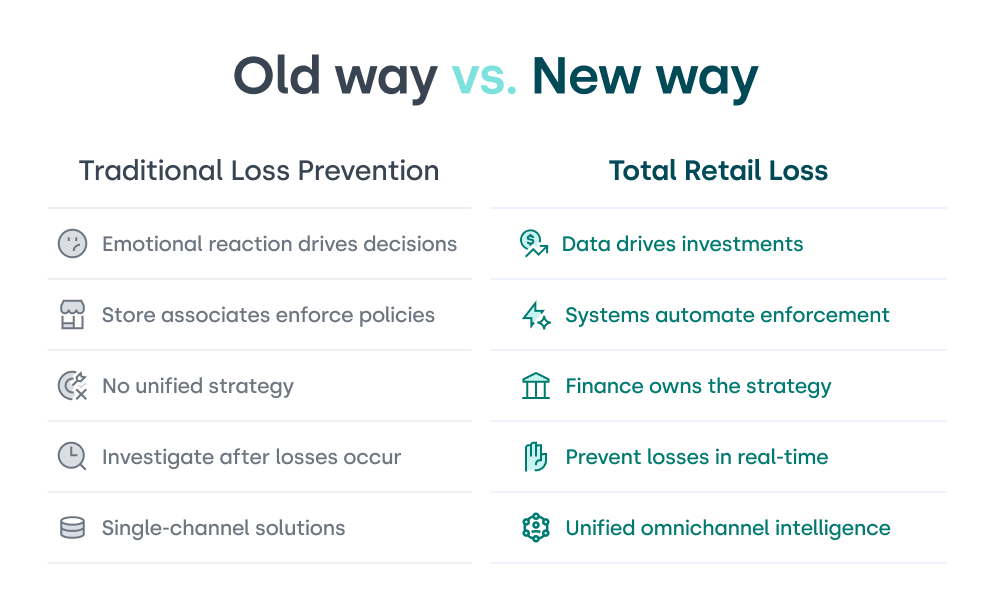
Frequently asked questions
What is total retail loss and how is it different from traditional loss prevention?
Total retail loss connects returns, fraud, and shrink data across all channels rather than managing them separately. Traditional loss prevention focuses on in-store theft after it happens. Total retail loss uses real-time prevention across all channels, revealing how the same bad actors create losses across multiple departments that can’t see the patterns alone.
How do retailers implement this without adding headcount?
Replace human decision-making with automated systems that stop fraud in real-time, like credit card processors declining suspicious charges. Store associates focus on customer service while technology handles enforcement. Consolidated data creates unified executive dashboards, eliminating manual correlation across departments.
What measurable results can CFOs expect?
One large general merchandise retailer—a top 50 company globally—reduced their return rate by 10% within the first year, creating $685 million in annual impact. That reduction affects multiple P&L lines simultaneously: every return represents dollar-for-dollar top-line sales loss, cash paid out to buy back used inventory, and margin erosion from reselling returned goods at discounts. An apparel retailer demonstrated the ongoing protection value when their system disconnected during an upgrade. Within 90 days, return rates climbed back to previous levels. Once reconnected, rates dropped immediately. CFOs gain unified visibility showing exactly how return reduction flows through to sales protection, cash flow improvement, and margin expansion across departments that previously reported these impacts separately.
Why do retailer market leaders prioritize this?
They recognize that managing loss categories separately creates exploitable gaps. Professional criminals systematically target these gaps across channels—receipt fraud creating shrink, online cancellations enabling theft, returns compressing margins. By treating this as CFO-level priority, leading retailers gain competitive advantages through better margins and efficient operations.